Phylogenomic analysis of Copepoda (Arthropoda, Crustacea) reveals unexpected similarities with earlier proposed morphological phylogenies
Seong-il Eyun
BMC Evolutionary Biology 17: 23

— Figures (Colored and High resolution) —
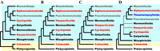
- Figure 1. Major phylogenetic hypotheses based on morphological characters of copepod orders, redrawn from A) Ho (1990), B) Huys and Boxshall (1991), C) Ho (1994), and D) Ho et al. (2003)
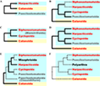
- Figure 2. Phylogenetic hypotheses based on molecular sequence data of copepod orders, redrawn from A) Braga et al. (1999), B) Huys et al. (2006), C) Huys et al. (2007), D) Minxiao et al. (2011), E) Tung et al. (2014), and F) Schizas et al. (2015)
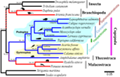
- Figure 3. The maximum-likelihood phylogeny of nine copepod species and nine other arthropod species based on the twenty four nuclear protein-coding genes
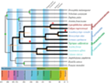
- Figure 4. Estimated divergence times among copepods
- Additional file 6: Figure S1. Bayesian analysis of copepod orders with morphological characters taken from Ho et al (2003) (pdf)
- Additional file 7: Figure S2. Bayesian phylogeny using the "degen-1" nucleotide coding sequences (pdf)
- Additional file 8: Figure S3. Bayesian phylogeny of nine copepod species with two outgroups (pdf)
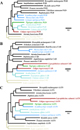
- Additional file 9: Figure S4. Maximum-likelihood phylogenies of copepod species based on a single gene region from A) 6-phosphogluconate dehydrogenase, B) carbamoylphosphate synthetase, and C) alanyl-tRNA synthetase (pdf)
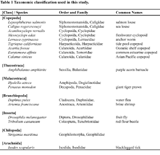
- Table 1. Taxonomic classification used in this study.
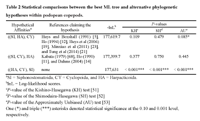
- Table 2. Statistical comparison between the best ML tree and alternative phylogenetic hypotheses within podopean copepods.
- Additional file 1: Table S1. Orthologous sequences used and identified in this study (excel)


— Copepod sequences used —
[copepod genes identified in this study]
- Additional file 2. This file contains the copepod amino acid sequences in FASTA format
- Protein alignments generated by MAFFT (in fasta format)
- Triosephosphate isomerase sequences
- Arginine kinase sequences
- Glucose phosphate dehydrogenase sequences
- 6-phosphogluconate dehydrogenase sequences
- Carbamoylphosphate synthetase sequences
- 26S proteasome regulatory subunit sequences
- Alanyl-tRNA synthetase sequences
- Glycogen Synthase sequences
- Acetylglucosaminyl-transferase sequences
- Methionyl aminopeptidase sequences
- Elongation Factor-1 alpha sequences
- Clathrin heavy chain sequences
- Vacuolar ATP synthase subunit sequences
- AP-2 complex subunit alpha-1 sequences
- Endomembrane protein 70 sequences
- pre-mRNA splicing factor RNA helicase sequences
- Cell division cycle 5 sequences
- Calcium/calmodulin-dependent protein kinase II sequences
- Enolase sequences
- Glyceraldehyde 3-phosphate dehydrogenase 1 sequences
- Histone H3 sequences
- Na pump alpha subunit sequences
- RNA polymerase II 18kD subunit sequences
- U1 small nuclear ribonucleoprotein A sequences
- Single gene phylogenetic trees inferred by maximum-likelihood Strigamia maritima (Myriapoda) and Ixodes scapularis (Chelicerata) are used as the outgroups. The numbers at internal branches show the bootstrap support values (%) for the maximum-likelihood phylogeny. The scale bar represents the number of amino acid substitutions per site.
- Triosephosphate isomerase
- Arginine kinase
- Glucose phosphate dehydrogenase
- 6-phosphogluconate dehydrogenase
- Carbamoylphosphate synthetase
- 26S proteasome regulatory subunit
- Alanyl-tRNA synthetase
- Glycogen Synthase
- Acetylglucosaminyl-transferase
- Methionyl aminopeptidase
- Elongation Factor-1 alpha
- Clathrin heavy chain
- Vacuolar ATP synthase subunit
- AP-2 complex subunit alpha-1
- Endomembrane protein 70
- pre-mRNA splicing factor RNA helicase
- Cell division cycle 5
- Calcium/calmodulin-dependent protein kinase II
- Enolase
- Glyceraldehyde 3-phosphate dehydrogenase 1
- Histone H3
- Na pump alpha subunit
- RNA polymerase II 18kD subunit
- U1 small nuclear ribonucleoprotein A
- Additional file 3. This file contains the copepod nucleotide sequences in FASTA format
- Nucleotide alignments generated by MAFFT (in fasta format)
- Triosephosphate isomerase sequences
- Arginine kinase sequences
- Glucose phosphate dehydrogenase sequences
- 6-phosphogluconate dehydrogenase sequences
- Carbamoylphosphate synthetase sequences
- 26S proteasome regulatory subunit sequences
- Alanyl-tRNA synthetase sequences
- Glycogen Synthase sequences
- Acetylglucosaminyl-transferase sequences
- Methionyl aminopeptidase sequences
- Elongation Factor-1 alpha sequences
- Clathrin heavy chain sequences
- Vacuolar ATP synthase subunit sequences
- AP-2 complex subunit alpha-1 sequences
- Endomembrane protein 70 sequences
- pre-mRNA splicing factor RNA helicase sequences
- Cell division cycle 5 sequences
- Calcium/calmodulin-dependent protein kinase II sequences
- Enolase sequences
- Glyceraldehyde 3-phosphate dehydrogenase 1 sequences
- Histone H3 sequences
- Na pump alpha subunit sequences
- RNA polymerase II 18kD subunit sequences
- U1 small nuclear ribonucleoprotein A sequences
- Additional file 4. This file contains the aligned and concatenated dataset used in this study
- Additional file 5. This file contains the data matrix of 54 morphological characters from Ho et al. (2003) in Nexus format